
SARA IMARI WALKER: The Physics of an Open Future
"Every generation has a new opportunity and decision to change the way the future looks."

THE CONTRIBUTOR
Profession:
Astrobiologist, Theoretical Physicist, Professor, Author
Location:
Phoenix, Arizona
Context:
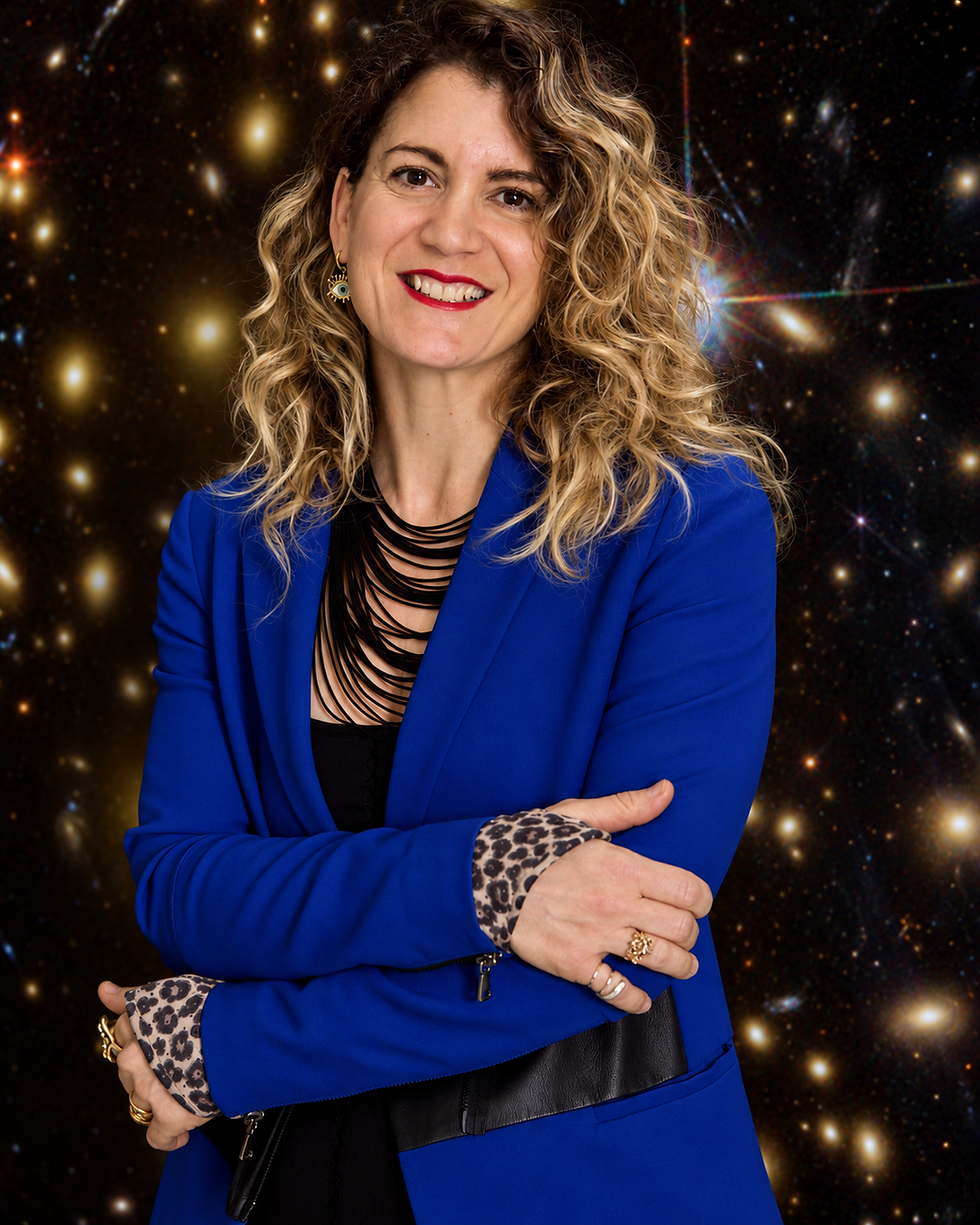
Sara Imari Walker is an astrobiologist and theoretical physicist whose work spans the origins of life, complexity, information, and the search for universal principles capable of distinguishing living from non-living matter. A professor at Arizona State University and Deputy Director of the Beyond Center for Fundamental Concepts in Science, she leads one of the world’s largest theory groups in origins-of-life research and has become a leading voice in the development of assembly theory. Her book, Life as No One Knows It: The Physics of Life’s Emergence, extends this work into a broader argument for rethinking life, time, causality, and the limits of contemporary physics. Beyond academia, Walker has become a public interpreter of foundational science, bringing these ideas into wider culture through conversations including the Lex Fridman Podcast, Joe Rogan Experience, and Sam Harris’s Making Sense, alongside major international media and public forums.

THE CONVERSATION

QU&A
What are 3 values that you wish to mediate through your work?
Loving what I do.
For me, that's really important because I don't know that I could do things I didn't feel deeply, intrinsically motivated to do. They feel very central to who I am.
Doing things that will make some kind of impact.
It's not because I personally care about making an impact. I want to do something that feels profound to me, for my own personal sense of value, but also because there are so many things we don't know, and it would be amazing if we could learn more.
I love the process of discovery. I value creativity because it’s very easy to work on ideas we’ve already had, and much harder to come up with novel ones. It’s also difficult to even recognize truly new ideas. I am constantly trying to do things that are not the way they've been done before and not the way they've been thought before.
I find joy in my work usually when I'm trying.
I do a lot of conceptual work. I observe how people think and how they describe ideas about how the world works. I read a lot of the literature on it. Then I try to think about [how] these are not exactly the ways that we need to describe it to solve this problem.
There's a giant conceptual map. I think in the past I've described it as a mosaic; you can see all the pieces, but they're not arranged into the right picture. A lot of my intellectual process is trying to rearrange those pieces. This is across a lot of different disciplines, from computer science to biology to chemistry. When you look at that whole map and start to see the pieces and put them together, every once in a while, things just click in a way that I don't think I ever saw articulated but would cover the whole map - and those are my most joyful moments.
What are 3 relevant problems that you wish to solve through your work?
I'm battling with what the fundamental limits of our ability to describe the world are.
By the time you get to things like us, there's so much architecture in our environment that was built by kinds of languages, or our understanding of the world, that it's really hard to know what the structure looks like outside of the way we talk about it - and also just what things are outside of a description.
This is the hard problem of consciousness. You have subjective experience. You can't relay that to someone else. It can't be talked about from the outside, yet we know it's there.
There's something about our ability to perceive our world and our ability to describe it that aren't exactly lined up.
I got interested in the issue presented to me in community college, which was this question of magnetic monopoles. They're interesting physical objects, but they don't actually exist. Any magnet has a north and south pole. You cut it in half, and it still has a north and south pole. What my physics professor was telling us in the first week of class was this idea of magnetic monopoles - just to point out that physicists had predicted them, and they could do experiments to look for them, but we hadn't found them yet.
For me, it was remarkable that a human being could write down a mathematical description and maybe understand something that we don't understand yet - but then use our ability to articulate it in a language to actually start to see that structure in the world.
I'm interested in why some descriptions of the world are more accurate than others.
I think a lot of the history of the progress of science. From understanding the fundamental role of gravity to electromagnetism, or understanding that there are distant galaxies and things.
All of these were related both to developing new theories and developing new technologies that allow us to perceive the world in different ways.
Even though humans, for all of our history, have had a deep intuitive sense of gravitation, we couldn't articulate it in a language that actually describes it the way we understand it now. It's so hard for us to understand what it was like 1,000 years ago talking about things without language for them.
ALIEN MATTER
From Representation to Understanding at Scale

The Limits of Representation
We can build descriptions of the world, and oftentimes, I think we confuse those descriptions with the world. You can think about pre-linguistic human societies: they had other ways to communicate, and they probably had other ways to mentally process information. Many humans still do this, but it seems like most people have taken language as the proxy for how they interact with the world and how they see the structure of the world.
We're constantly exchanging these bits of information that are representations of reality. We live in a very deep culture that has a lot of acquired knowledge over many, many generations, from things about the fundamental nature of particles and fields to what is a good fashion aesthetic. Societies are very deep, and we are steeped in all of this information. It's becoming increasingly hard for us to see what the world looks like outside of humans - and humans’ interpretation of the world.
I was kind of hopeful artificial intelligence would help with that - that they'll see the world differently - but they're so steeped in human perception of the world and human data that I think they're just reinforcing the current representations that we have of reality.
One of my greatest fears right now, existentially, is that we're just going to become closed in, and we're going to think we know it all, and the world's done.
I just see this giant horizon of all of these amazing things we haven't done yet or we don't know yet. The future is very open, and I think that's very characteristic of the physics of life.
Across Scales: Individual, Society, Algorithm
In science, if we go back to the question about defining life, it's not very clear cut: how you should say this thing is an "individual". Therefore, the individual unit is life. In my book, I gave some examples about this, which are related to this question of societies. You might say an individual is the reproducing unit, or an individual is the thing that can survive on its own. In the case of modern humans, neither of those things are true for most people. I would not want to be giving childbirth on my own outside of society. I think most people wouldn't, and I certainly couldn't be one of those people that just goes and lives in the woods by myself and survives more than a few weeks.
I think most of us are much more dependent on societal infrastructure than we think about on a daily basis - for our sustenance and our survival.
Also, we grow up in environments where all of the ways that we think and are are influenced by the society that we're in. So we're not really individual, autonomous units in the way we think we are. We really are part of these societies. Some of the decision-making that happens at the collective scale are things that no individual would necessarily agree with - or individuals are flummoxed to really understand.
I'm always interested in social media. People get so angry on social media, and it's such an individual battle - but if you look at it as a collective system, it's super interesting that a society is structured to have these groups adopt very strong opinions. It's not an individual-level discussion anymore. I think people don't really recognize, when they're engaging in these things, what the role of this is from the societal or collective perspective. There is selection and evolution and all kinds of processes that we would think are deeply biological and related to life that don't happen at the scale of individual humans, but happen at the scale of our societies or interactions of societies.
There’s also some really great work in that space, thinking about the role of AI as more of a cultural technology. As individuals, when we interact with artificial intelligence, it’s like, "Oh, this is so human-like. I’m talking to a person, but it’s a computer". But you don’t have a conception of how much cultural memory has to go into that computer being able to basically be a giant predictive lookup table. You have to have thousands, if not millions, of years of human evolution to get to something like this. So you have to invent spoken language and written language, and you have to have an accumulation of enough knowledge and invention of digital computers and things to even archive that and then learn that behavior and store it in a memory device.
When you're interacting with an algorithm on your computer, you're interacting with thousands of years of human history.
Of course, if you can store all that information and dynamically access it, like you can with a large language model, it's not surprising that it looks like it's imitating a human, but really, what you're doing is interfacing with a human societal construct. And so I think we don't really understand the different levels of time and space and what human is, and then how that's manifesting in the machines that we're creating.
Beyond Language
I never had trouble with mistaking algorithms for an emotionally deep thing. I think it's probably because I already don't have the same interaction with language that most people do, because I use language as a tool for trying to see the patterns that people don't articulate in language. I'm trying to understand concepts that we don't know how to articulate underneath.
Once you start interacting with people in conversation, if you start to see past the words and what they try to convey to you, it's a totally different conversation. If you aim to go from the experience of the person and really understand their background - that kind of exercise is really good, because you start paying attention less to language and more to the actual meaning. And, you know, the thing with large language models is they're completely devoid of meaning.
ORIGIN OF LIFE
Overcoming Myths and Challenging Practices

The Physics of Design
I have lots of ways of describing life. I don't have one definition. I carry with me probably 10 working ones at any given point, and some of them are a little orthogonal to each other, just to maintain this space. But one of the things I always think is very deeply intrinsic to life, independent of any theory that I ever develop, is that life is a mechanism for the universe to generate novelty and creativity.
Unless you take creativity as kind of fundamental to the way reality works, then all of the things we're doing on this planet are completely nonsensical. How would you explain any universe that wasn't creative? It's almost what I'm trying to do is the physics of design. It goes back to these age-old evolutionary debates: before Darwin and all of the early work on evolutionary theory, we thought the world was static in time, and there were no new things that ever emerged. Then we get to this point where we have this theory of evolution, and evolution is natural design. Natural selection was hugely contentious because it wasn’t a God designing the universe anymore - it was nature itself doing it.
Fundamentally, we still don't really understand how it is that the universe can design itself. This is the problem of the origin of life.
So you have to build a theory that explains natural design and why it is that the universe can design itself. The way that we do that is really thinking about design coming from history. New structures can only form based on existing structures. And the way that we formalize a conception of life within that space is that life is the mechanism of creating novelty. There's no way to make that structure in the absence of having a memory and a history, and acquired information over a lineage of successive generations of things building new and new structures. So that becomes the fundamental conception of physics, and that there's a complexity threshold associated with life where you could uniquely identify that this physics is occurring.
The Problem with Definitions
The traditional conception of a definition is that you understand what the thing is and therefore should just take the definition at face value. Through the work that I do, I've started to think about definitions more as thought experiments. If you're doing good theory, a definition for something should emerge out of the theory.
Obviously, the example of interest in my work is defining life, which is a very difficult problem. It has been an open question for thousands of years, and there are lots of definitions in modern science for what life is. They include things like a self-replicating system, a self-sustaining chemical system, or something that must eat to survive. You can open a biology textbook and find many potential candidate definitions.
The issue with trying to come up with these definitions is that we're trying to define a phenomenon that we actually don't understand. So we take little pieces of its structure that we see in the world. All the organisms we see reproduce, or somewhere in their history, they had to reproduce. Therefore, reproduction must be fundamental for life, and we define life as reproduction. But then you find self-reproducing systems that don't seem to fit what we would intuitively suspect as life. All of these definitions have gray areas.
It's challenging when you want to ask a question like the origin of life because you need to define the thing in order to ask how it originates. In working on origins of life, there are many people who have chosen to define life first and then try to solve the origin of that thing they defined. I think that's not the right way of doing it. You need to confront the origin of life question directly. You need to ask what the mechanisms for the emergence of life would be, knowing you don't yet have a definition for the emergence of life. This is hard. This is why it gets circular and challenging. Then you try to do thought experiments and build theory that iteratively help you come to a more objective kind of definition.
I always use gravity as an example. I really struggle - and I should probably look in the historical literature - to find examples of how people talked about gravity before Newton and Galileo. They probably talked about the force of the Earth. Aristotle, for instance, talked about different forms: things that are air-like move up, and things that are earth-like move down. So there were obviously some concepts, but not the way we articulate it now.
I don’t find definitions particularly useful unless you’re willing to throw them away or to say there are many ways of defining a thing, and you’re not going to accept any one way as the absolute final one.
This is true of human language too: the meanings of words change over time. You can see that even in your own lifetime. There are ways my kids use words that completely surprise me. My daughter calls me “queen” all the time. It’s really cute, but it’s not a word I had as slang when I was a kid. It’s so weird; I don’t know what to do with it.
These kinds of examples are important because definitions are useful in science, but they’re not absolute statements about what a thing is. My strategy in working on origins of life was to read all the definitions, understand what features of life they were trying to capture, but not accept any as the right answer. I tried to figure out how you could develop a theory to describe the regularities we associate with life - the patterns we see in the world that life generates - and then how you would test that theory. If you have a theory that’s testable in that way, then you can try to define the phenomenon, because you’ve actually identified something that has an objective clarity in nature, not just part of our subjective experience of it.
ASSEMBLY THEORY
The Importance of Theory in Discovery and Creation

Theory as a Description of Reality
For me, theories are very deep, fundamental explanations for the way the world behaves. That's not usually what people think of when they think of theory, particularly in theoretical physics or in science generally. Usually, they think you have a mathematical form for an equation. I think a theory, a good theory, is about reality. And because we have to share theories with each other in order to do science.
Science is a consensus act. It's not the act of an individual; it's a societal act - you actually have to write a good theory in a symbolic form and share it with people and have them have a common understanding of the way the world works.
So that's actually the challenge of theoretical physics: taking a fundamentally new description of the world that describes some observed phenomena that we couldn't actually understand properly before. Describing it in such a way that we do understand it, but describing it in a way you can share it with other people and have it be precise. That's really, really hard to do.
The mathematical representation should not be confused with the meaning of what they're trying to describe about the world. This is why Einstein was such a brilliant scientist. He makes this point: in order to describe space and time, you actually have to define a coordinate system. The coordinate system is a mathematical structure that allows you to say these two points have this relationship to each other. Depending on what coordinate system you set, you actually can introduce mathematical artifacts into the way that you're describing space and time. Einstein's struggle was that he could understand conceptually, because of his thought experiments with the nature of light, the speed of light, and a fundamental speed limit, and thinking about the principle of invariance in physics at the reference frame - there should be some features that are independent of reference frame and other features that are dependent on it - but you have to put all of that in a coordinate geometry. He knew what the structure should look like, but he couldn't figure out the way to build a mathematics that would describe what he thought. And so it took ten years.
Most people are not that disciplined that they really feel like their intuition or their concept is right. So they get a mathematical representation, and it's either good enough, or they don't know how to think past it. Then they get stuck on that, and use that and run with it.
These mathematical representations are not the world, and oftentimes they're not even good maps of the world. They're projections that we have that allow us to start playing with the patterns we see in the world. Sometimes we just completely lose sight of that, and then we just start playing with labels on reality.
This is a lot of what machine learning is doing to science. It's kind of just giving up understanding for reading data. I think that's going to be catastrophic if we don't actually have more work that goes back to first principles and really thinks about what the data is representing, and how we do measurements to validate this. It's not just a human, subjective, perceived way of categorizing the data associated with the system. It's something about that system - intrinsic to that system - and not us as systems interacting with it. It's deep, and it requires time, because you're basically asking your brain to build new descriptions of reality that it's never encountered before and hasn't learned from someone else.
Human Creation and the Open Future
One of the things that we underappreciate is how much of our environment is built from human minds. We live in a very small part of reality, like planet Earth, where almost everything in our environment was constructed over billions of years of evolution. I think when you have the sort of scales of space and time that you think about yourself being situated in, it puts things in a lot of perspective. With just appreciating the world around us - artificial is not bad. It's just things that take a lot of evolution to get to. Once you realize things that are made by humans are not bad, they can be good. The natural world also has many qualities that are good and maybe some that we might think are bad.
I don't know how to assign moral values, actually. I'm saying this like there's some objective scale, but there's probably not. So then that becomes a conversation about what do we want the future to look like? What kind of things do we value for the future? A lot of traditions, particularly in the cultures I grew up in, like Western culture or scientific culture, have really not focused on this idea about the future being open.
Every generation has a new opportunity and decision to change the way the future looks. That's a lot of responsibility.
We don't think about it because our lives are so short that it's easy to think everything happens over a span of 100 years, and that's the only thing that's interesting because it's the maximum human lifetime. But that's not really true. And we know that's not true, but our lived experience doesn't reflect that. So I think just being more aware of the way that we can purposely build better futures is really important.
AI as Cultural Technology
I anticipate [AI] will be very good for some scientific problems and really bad at others. A lot of it for me is: what is science as a societal system? And then what is science as a method of hypothesis testing and a mechanical, automatable procedure? When I see people say AI is going to do all of science, their conception of science is what kids learn in second grade. It is not the lived experience of science as a human culture or what science is actually trying to generate as far as foundational knowledge.
A lot of what we struggle with in science is this idea of scientific consensus. People that work in a certain field have to agree on how they think about the world. And if you are machine learning things, and everything that you're supposed to think about the world is behind a black box, how are you supposed to build a consensus understanding out of that kind of reality? So I think it's challenging to know how these things are going to interact with societies.
We have built a society-level technology, a cultural technology. We put language in a box and made it dynamically interactable with, and now we're confusing that with an individual human, instead of thinking about what is the role of that in changing the dynamics of the social structures in which it's interacting.
All of the data it gets is stuff that we put into it. It’s a very big mirror, in terms of the amount of data it can process. So I think it is useful as a technology of measurement, but what it’s measuring is our information ecosystem. These machine learning models are basically allowing us to compress our own data and interact with it in new ways. But the question always remains: how does data get into the information ecosystem? And that’s sort of where the boundary is. I think that’s the issue: how do you build new representations?
That’s where I think artists and scientists in particular have always played a really important cultural role, and why they’re always rebelling against the current at the time - because they’re trying to figure out what are the things that we’re not doing right now.
So I don't see artificial intelligence replacing scientists. I don't see it being very useful in all areas of science, but I do see it as an incredibly useful tool in some areas of science. It's more at the level of industrialization. If you have robots do things for you, that's great, and if you have machine learning algorithms to automate some parts of the scientific process for you, that's great. I think that will change the ecosystem of science and the way that we do it, but I don't think it's in a lot of the ways that it's being talked about or sold. Mostly, that's because tech companies just want you to buy their algorithm.
I'm actually really surprised by how many of my colleagues are scared about the threat of AI taking over. I'm shocked. I don't understand how people could think it was a legitimate threat. It'd be like people telling me that AI was going to replace artists. I just don't even understand what that means. It's nonsensical statements from the start. Cameras didn't replace painters. I don't know why, and I don't think we've ever had a case where a technology was predicted to replace something entirely, and it really did that. What it does is new technologies change the ecosystem of all the dynamics of these very complex, interacting parts.
The challenge is that we have new technologies, and we don't know how the entire cultural-technological ecosystem is going to shift. The strongest voices right now tend to be the ones that have the most market gain. So you have a fast economic narrative and then a slower creative, intellectual narrative that is developing now with people who are thinking very carefully about these technologies. But that's not the way that we're going to be talking about it for 10 or 20 years, because that process got slower.
A Universe Deep in Possibility
I love thinking about the historical development of science and how long it took us to realize how deep time is. For most of human history, we thought the Earth was not that old - maybe a few human generations. And now we know it’s billions of years old. Or how big space is - we’re on a planet, we see stars at night, but they’re just on a fixed globe around the planet. Oh wait, no, some of those stars are thousands and thousands of light years away, and there’s dimmer light that we can’t see that’s billions of light years away. So we understand the universe is deep in space and deep in time.
Assembly theory is the idea that the universe is also deep in terms of the possibilities it can create and the amount of structures it could have. Our planet is very deep because we have had life evolving on this planet. We have memory of past events and all of the structure that life has built. More things can happen on this planet than anywhere else we know of in the universe right now.
That, to me, is as physical a space - a space of possible things that we can create - as a coordinate of moving across a physical space or counting time on a clock. It’s just not one that we’ve figured out how to measure yet. And that’s really what assembly theory is trying to get at: that life is these structures that are very deep in possibility and deep in causal history. And how do we formulate those things and make a more precise way of talking about this?
I still think humans are the deepest structures that we know of, even despite all of our technology. I think the biosphere as a whole is a very deep structure, and we’re obviously deeply integrated with it and not really individuals. We’re all just lineages interacting over time.

What is the value of theory in fundamental understanding of reality?
How do we understand what science's cultural contributions really are?
This conversation contributes to a new media format, where Contributors are in full control of their narratives. By exploring alternatives to narrative journalism, GAHSP starts unconventional conversations, emphasizing values and problems that shape our lives collectively.
Conversation Led by Julia Horvath
Multimedia Concept by Julia Horvath
Photography and Videography by Adam Nagy
Image and Video Editing by Joseph Shahum
Production by GAHSP SYSTEMS
Image Courtesy of GAHSP MEDIA
Location Courtesy of Arizona State University
Unedited. Only Formatted.


Comments